← All work
Energy & Power Markets · Live

ReactorScale

U.S. Advanced Nuclear Development Intelligence

What is actually being built, separated from what is merely being designed.

Open the live project →

Status
Deployed and public
Timeframe
August 2026
Role
Sole author — registry design, validation architecture, dashboard
Built with
React · Vite · EIA-860/923 · NRC filings · Automated data validation
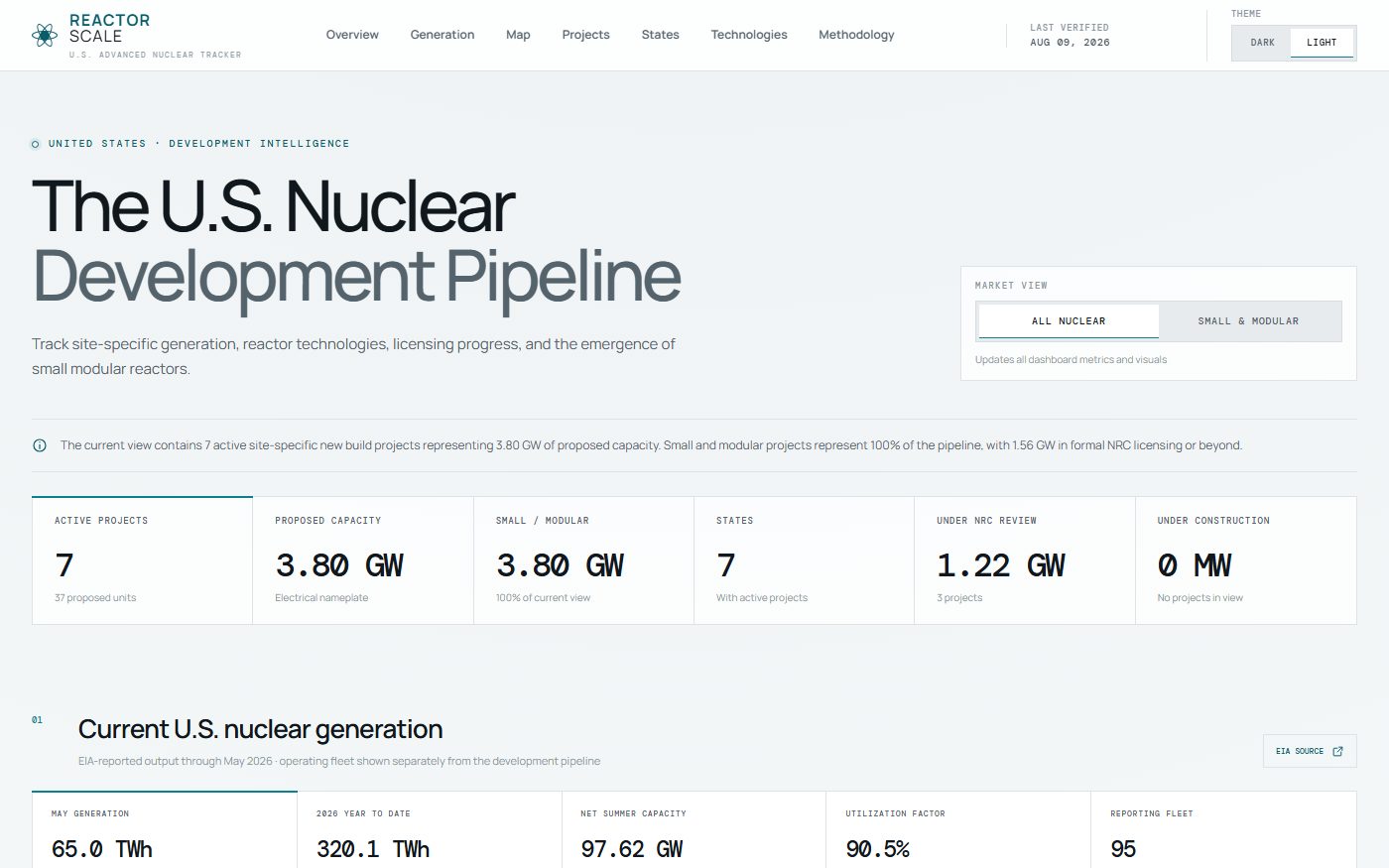
Screenshot of ReactorScale
ReactorScale — captured from the live site
4
validated data registries
6
automated integrity checks
May 2026
operating-fleet data through

The question

Advanced nuclear coverage runs on a category error. A reactor design receiving regulatory attention and a reactor actually being built at a named site are wildly different facts, and headline capacity numbers routinely add them together. That produces a pipeline that looks far more real than it is.

What I built

A dashboard that structurally separates site-specific deployment projects from design-level activity, and calculates every headline metric from the filtered project registry rather than from a hand-maintained total. Research and test capacity is explicitly prevented from entering commercial generation figures.

Four separate registries — deployment projects with sources and events, design-level technical attributes, the operating fleet from EIA-860 and EIA-923 through May 2026, and a review queue holding plausible findings excluded from totals pending analyst review.

A validation script that runs before any build ships: capacity bounds, coordinate sanity, source presence, duplicate detection, stale-record age, and scope conformance. The current U.S. nuclear generation module is deliberately kept apart from development metrics and carries its own explicit release and data-through dates.

The hard part — Building an analyst review queue instead of a judgement call

The tempting design is to include a borderline record and add a footnote. That makes the total wrong and the footnote invisible. The alternative — dropping it — loses the finding entirely and it gets rediscovered three weeks later.

The review queue is a first-class registry instead. Plausible-but-unconfirmed findings are captured, kept out of every total, and surfaced for adjudication with their source dates and quality grades visible in each project drawer. Nothing enters the headline numbers on a maybe, and nothing found is thrown away.

The honest framing carries through to the scope note: these records are a public-source seed dataset built to prove the product architecture, not a claim of exhaustive U.S. market coverage. Saying that plainly is what makes the numbers usable.

What this does not tell you

  • The registry is a public-source seed, not exhaustive coverage of U.S. advanced nuclear.
  • The next phase is a reproducible NRC/EIA/DOE ingestion pipeline with change detection — currently the update path is semi-manual.